Showing posts with label Currencies. Show all posts

Wednesday, June 1, 2011

Driver of Long CADMXN @ 11.91 spot

A few days ago, on Twitter, I posted about a long CADMXN trade @ 11.91 spot ref.

Why?

In my opinion Mexico is a structurally worse country than Canada.
And Mexico's exports are MUCH MORE linked to the US than Canada's.

Canada is a Commodity behemoth: timber, coal, oil+gas, mining. Mexico has oil as very relevant.
Canada has a much more developed social, political and educational system.
Canada has no issue with crime+violence. Mexico does.

Canadian interest rates are already very low and its interest rate curve is not as steep as Mexico's. This means that not a lot of room for easing in rates, unlike Mexico, in case activity drops further. Last year, for example, the markets, for a brief moment, priced in rate cuts in Mexico. Mexico has a base rate of around 4.50%. Not to mention that Mexico has also a dovish central bank.

(A) I consider the "long Mexico" trade (through NDFs or local-currency-denominated bonds) more crowded than the "long Canada" trade.

If I am correct in (A) hot-money flows into Mexico have been considerable and the technical position of the market should be good for the trade.
Remmitances from the US to Mexico (from immigrants, hail to Western Union!) has not improved much since the crisis and the pace of increase has been reduced.

Mexico and its links to the Auto Industry will be more impacted by Japan, even if short-term. Recent economic data have shown that. Its job recovery hasn't been very robust either.
Its domestic demand hasn't fully recovered from the crisis, with industrial production or unemployment or retail sales levels still below those reached back in 2007-2008.

All-in-all, this is a low vol trade, with both currencies with very, very strong correlation to risk-on/risk-off behavior.
Tail-risk seems to be tilted to our side (CAD moving higher x MXN).

Canada has weaker links to the US and structural fundamentals look better in my opinion.
Drawback is certainly the carry. For a low-vol trade this makes a difference because the waiting costs money.

Tactical trade here. Not a long-term trade. Something for 1 month or so, 3-4% gain target.

(1) Links to the US
(2) Interest rates in Mexico can go much lower than Canada's
(3) Flows into Mexico I believe have been more speculative/short-term than Canada (FDI x bond buying for example)
(4) Levels CADMXN at the lows since 2009


*Disclaimer: charts and data are presented as I receive/see them. Sources are usually not checked for validation and my own calculations are of 'back of the envelope'-type. I am aware that some math that I do myself might be wrong and/or misleading to some extent. In financial markets the rate of change of economic data is often more important than the actual level and the perception of 'what is priced in' is more important than 'what is actually going to happen'. This is actually the way people pick entry and exit points. So... yes, sometimes you might say 'This guy is an idiot, this is way wrong!' with a high conviction, being right. Not to worry. Markets are made of expectations and the clash of conviction between its participants. Portfolio managers know that being an idiot is sometimes profitable and being smart is often a bad choice. It is all reality, sometimes good, sometimes bad. By the way: corrections to my analysis and intelligent debate is welcome. theintriguedtrader AT gmail do com

Tuesday, May 31, 2011

New Trade: USDCNY 3y Calls

So I have posted about this one trade in currencies:

LONG combination of these:commodities + strong domestic demand + good demographics and room for productivity gains + balance sheets + high yields > BRL, CLP, CAD, NOK, CHF (30% / 15% / 20% / 20% / 15%)

versus

SHORT Printing Presses: USD, EUR, GBP (33% each), perhaps short 3-5% AUD.


The drivers are pretty straight-forward: I do not believe these countries will be able to get out of their current economic situation without printing their way out.
The Americans have a huge pile of sovereign and private debt. Policy makers won't be able to either raise interest rates or cut fiscal stimulus. Stimulus means printing. Raising rates means risky-markets should collapse bring economic activity with it. That means more all-kinds-of stimulus.
Repeat for the EUR block.
Repeat for the UK.

These 3 guys are now into the deleveraging process, coupled high unemployment, high fiscal deficits and retiree-wannabe-but-can't-cuz-I-got-no-savings baby boomers. Not to mention they have spent their small savings on an iPad 2 and a bunch of apps.

On the long side of the equation we have countries where demographics in most cases should remain reasonably good, where balance sheets are much, much better on aggregate, where real interest rates look better, where domestic demand is also reasonably robust and their exposure to commodities and global growth is alright.

What do they lack? They sort-of-lack capital. And that's the main risk to the trade.

Stress in the global financial markets means invested capital (hot money flows and FDI) fleeing these countries would happen, as history has taught us.

In this case we have added the CHF as the safe-heaven currency. And also we could get some JPY there even though I am NOT a fan of Japan. But these guys have massive savings in external assets and a (currently) positive current account. Capital flies to japanese-quality heaven when things go sour. This means in stress, as history has also shown us too, the JPY could also reduce the volatility of this trade, improving its risk-reward profile.

NOW.... I am siding with Mark Hart (Corriente Advisors) and Jim Chanos (Kynikos) on a bet against China.

First: because in case China goes bust or slows downs considerably these commodity-linked Currencies will take a beating. A hard one. Like they did in 2008. The Commodities market went bust before the Armageddon hit global equities. So currencies took a beating then too. That was China and its Housing Starts numbers going south in late 2007-early 2008.

Second: fundamentals.
Credit expansion (what a boost they had in early 2009, throughout today!) has been huge.
This credit fueled an impressive streak of fixed asset investments, but with overcapacity now lingering in some sectors and the domestic demand unable to pick-up as fast consuming these investments (be it through usage of roads or the purchase of 1st homes, etc) it seems to me some of this returns are bad and the credit is heading towards default.
Inflation is picking up, with food inflation being the worst (some say 10%), ghost towns are being formed (lots of videos on this out on the web, Frontline, Bloomberg, etc).

Third: Asymmetry
The market is packed on the long-CNY trade. That means lots of people selling volatility, perhaps to fund the short USDCNY trade through NDFs. Even though nominal rates in China are higher than those in the US the NDF curve is inverted (contrary to the curves in Brazil, Chile, Australia, etc, etc, etc). Investors are piling onto this trade and the NDF curve 3 years out has an implied 5.2% appreciation (1.70% year) even though rates differentials point to an 8% depreciation. That is a 13.2% gap. OK, I won't argue that market prices are market prices. But I'd like to accept this distortion which I find favorable.

With the CNY spot being controlled by the Chinese the market has priced in very, very low implied volatility for options on it.
And that means opportunity. Skew.

So what is the call here?
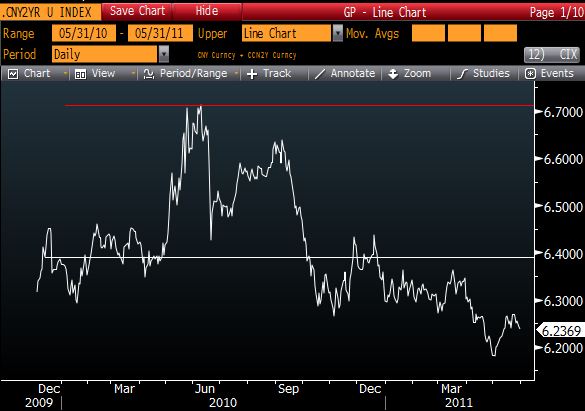
Buy 3y USDCNY Calls with a Strike of 6.80 (put CNY / call USD)
OTM from Spot: -4.7%
OTM from 3y fwd: -9.4%

Volatility was offered at 7.2% and the premium at 1.63%.

In 2010, when the European Debt Issues started roiling markets the 2y NDF (so consider this trade one year from now...) went from around 6.40 to 6.70, that is a 4.70% move. And historical volatility went from the bottom of 4.5% to around 10.60%. And implied volatility trades above historical volatility.
So with a decent stress I see this trade paying at least 3/5 to 1, so 5%-8% return. If the stress is actually bad enough (EUR taking a beating?) I see this multiplied by 2 or 3.

So...

The currency basket is a high yielding play with lower volatility due to its construction. It should perform well with low yields in the US/UK/Europe, with modest-to-low growth in these countries and the on-going growth in EM (read China). Basically status-quo.
And the HEDGE (CNY put / USD call), to me, is considered another new trade, but it actually adds to the portfolio nicely as I believe it serves a great hedge in case the world goes buh-bye again.

Opinions?
Questions?
"You are wrong!"?


*Disclaimer: charts and data are presented as I receive/see them. Sources are usually not checked for validation and my own calculations are of 'back of the envelope'-type. I am aware that some math that I do myself might be wrong and/or misleading to some extent. In financial markets the rate of change of economic data is often more important than the actual level and the perception of 'what is priced in' is more important than 'what is actually going to happen'. This is actually the way people pick entry and exit points. So... yes, sometimes you might say 'This guy is an idiot, this is way wrong!' with a high conviction, being right. Not to worry. Markets are made of expectations and the clash of conviction between its participants. Portfolio managers know that being an idiot is sometimes profitable and being smart is often a bad choice. It is all reality, sometimes good, sometimes bad. By the way: corrections to my analysis and intelligent debate is welcome. theintriguedtrader AT gmail do com
Wednesday, May 11, 2011

Speaking of currencies...

Heck if this is important, but I will post this anyway. It is an introduction to what will follow.

Below 2 charts.
- UK's Non-EU Trade Balance, 12m rolling sum, in 10^6 GBP.
- UK's Total Trade Balance, 12m rolling sum, in 10^6 GBP.


The trend seems clear. An american high-school cheerleader would say something like "Oh. My.God. The Industrial Revolution is soooo 1800's".

The country has bad deficits, high debt-to-GDP, banks that were nationalized, activity that has been stagnant for the past 6 months, high unemployment, high inflation and still loose monetary policy. Did I mention they're tightening fiscal policy (still loose). Issues with London losing the battle against other global financial centers.

Would you like to buy Sterling? Only if I had the time to go check out the Royal Wedding, my friend!

The GBP is included in the "Printing-Presses" currency category I have here on my side together with the USD and the EUR.

The JPY should be included also as these guys are THE owners of Canon, Kyocera and the likes. They MASTER the skill of printing. They invented Quantitative Easing! BUT, on the other hand, since their stocks have moved down 75% since their bubble peak in 1989-90 and their bonds can't go much higher (bad risk-reward, 30year @ 2.03% with 105% net debt/GDP, 200% gross debt/GDP, bad demographics, low savings rate) they have been investing abroad for years. Their stock of wealth abroad is massive. So, contrary to what is considered common-sense for every other country in the world, the japanese currency, the yen, actually appreciates when there are market stresses. Natural disasters, financial disruptions, etc, all make the Yen go up, especially against the USD. Wow. Now add positive net-exports flows... Positive current-account... and you get the Central Bankers of the world intervening in the market selling the yen to try to stop the trend. Right after the earthquake we heard from a currency dealer 'Our yen books are cleared now. ALL stop-losses have been triggered". That was right after the JPY rose 3.80% in 15-minutes. And the BoJ came to the market.

So if I were to add the JPY to a basket of currencies it would be on the 'long vol' side. Buy long-term deeply out-of-the-money YEN puts while buying some spot JPY. Why? Well, it seems to reduce the overall volatility of the basket in periods of stress.

A basket I am very interested in at the moment is:
- short USD, EUR, GBP (33% each), perhaps short 3-5% AUD.
- long BRL, CLP, CAD, NOK, CHF (30% / 15% / 20% / 20% / 15%)

I'd include the JPY on the long side @ 5% of the basket, to reduce stress-volatility, increase the sharpe of the trade, taking 1% from each other currency, like the CHF.

This basket has a decent carry, especially nowadays!, bets against bad balance sheets and negative real interest rates.
The long side is structural commodities + higher growth + better stablished banking system (CHF = gold) + bit better demographics

It has performed very well since the end of the crisis, 15%+ since June 2010. And I expect it to keep performing well.
Downside risk is massive stress, like seen in 2008, before the printing presses are set to full-throttle again.

Even though the long-countries have better balance sheets they're still net-debtor. A lot of foreign capital within these economies that could be pulled out. Their higher growth is of course dependent on that. Not to mention their foreign reserves that contain US Treasuries, etc.

Anyway... Currency trends tend to last for years, decades and I do not think we're at a turning point yet. If you consider the drivers of growth on the two sides of the equation here I believe the basket is looking good: (A) population growth + (B) marginal productivity gain. The only time this doesn't work is when there's no capital to support A+B, which is global financial stress.

So... what do you think? Emails to theintriguedtrader@gmail.com are welcome with a brief background of yourself.


*Disclaimer: charts and data are presented as I receive/see them. Sources are usually not checked for validation and my own calculations are of 'back of the envelope'-type. I am aware that some math that I do myself might be wrong and/or misleading to some extent. In financial markets the rate of change of economic data is often more important than the actual level and the perception of 'what is priced in' is more important than 'what is actually going to happen'. This is actually the way people pick entry and exit points. So... yes, sometimes you might say 'This guy is an idiot, this is way wrong!' with a high conviction, being right. Not to worry. Markets are made of expectations and the clash of conviction between its participants. Portfolio managers know that being an idiot is sometimes profitable and being smart is often a bad choice. It is all reality, sometimes good, sometimes bad. By the way: corrections to my analysis and intelligent debate is welcome. theintriguedtrader AT gmail do com