Showing posts with label Weekly Recap. Show all posts

Friday, July 15, 2011

Weekly Recap, 2011 07 15

Another week and more fears, huh?

Italian and Spanish bond yields broke to the upside from that range we mentioned weeks ago and they certainly don't look any good.
The Stress Tests today were mild and sounded like good news, but I wonder, really, what is in there.

Some interesting facts are:
- US Electricity Output has come down YoY.
- US Railroad Freight Carloads are also down YoY.

A lot of revisions to US 2Q and 3Q growth started to pop up and Bear-man-QE was, as expected, super dovish in his comments this week.

I am not seeing a lot of good macro trades on the table right now.
I like surfing what I got, but major new ideas are not cheap on the table.


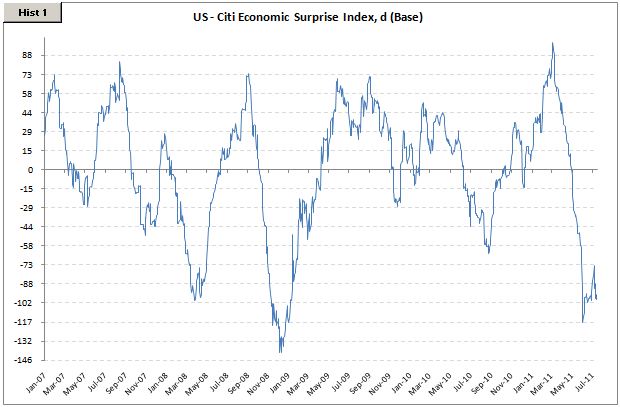
Now to those charts no one cares about:


*Disclaimer: charts and data are presented as I receive/see them. Sources are usually not checked for validation and my own calculations are of 'back of the envelope'-type. I am aware that some math that I do myself might be wrong and/or misleading to some extent. In financial markets the rate of change of economic data is often more important than the actual level and the perception of 'what is priced in' is more important than 'what is actually going to happen'. This is actually the way people pick entry and exit points. So... yes, sometimes you might say 'This guy is an idiot, this is way wrong!' with a high conviction, being right. Not to worry. Markets are made of expectations and the clash of conviction between its participants. Portfolio managers know that being an idiot is sometimes profitable and being smart is often a bad choice. It is all reality, sometimes good, sometimes bad. By the way: corrections to my analysis and intelligent debate is welcome. theintriguedtrader AT gmail do com

Friday, June 24, 2011

Weekly Recap, 2011 06 24

Another week and the European debt issue goes on.
What has changed? In my opinion nothing changed regarding fundamentals and drivers of positions. It actually got a bit worse because the cost of rolling debt or issuing new debt has gotten worse.

Why? Simply because what happened is what everyone expected would happen: policy makers trying to cool the fire. Even though the voting in Greece was positive and the news that the Greek government and the IMF have struck a deal on what the austerity program will be in order for the Greeks to get the aid.

And markets and the funding costs?
Well, as the price board below shows the markets have not calmed.
- Sovereign Bond yields for Italy, Spain, Portugal (and the others) have gone up and broke resistances to the upside.
- Rates derivatives demonstrated an increase in stress in short-term funding markets, widening 5bps (Sep11 and Dec11 USD 3m Libor futures).
- The EUR took a beating
- The European Financial Index lost almost 4% this week.

As Albert Edwards quoted others here the whole issue is in the hands of politicians from debtor and creditor nations. And it takes only a handful of people to go against all the austerity programs or bailout programs with taxpayer money to ruin it all.
Argentina did it.
Iceland did it.
Greece didn't because they do not have their currency. Otherwise I believe they would have already done it.


Now those useless charts on weekly data:


*Disclaimer: charts and data are presented as I receive/see them. Sources are usually not checked for validation and my own calculations are of 'back of the envelope'-type. I am aware that some math that I do myself might be wrong and/or misleading to some extent. In financial markets the rate of change of economic data is often more important than the actual level and the perception of 'what is priced in' is more important than 'what is actually going to happen'. This is actually the way people pick entry and exit points. So... yes, sometimes you might say 'This guy is an idiot, this is way wrong!' with a high conviction, being right. Not to worry. Markets are made of expectations and the clash of conviction between its participants. Portfolio managers know that being an idiot is sometimes profitable and being smart is often a bad choice. It is all reality, sometimes good, sometimes bad. By the way: corrections to my analysis and intelligent debate is welcome. theintriguedtrader AT gmail do com

Friday, June 17, 2011

Weekly Recap, 2011 06 17

Another week and not a lot has changed.


Below some parts of e-mails I exchanged with friends regarding the European situation:

I like going long Germany CDS at current levels, 40bp.
I think this says it all.

Not that Germany will default, but compared to costs on limited risk bets with a 6month expiration (puts on DAX, SPX, EURxsomething) it seems cheap.

10yr spanish bonds broke today to the upside and Italian 10yr tested the break-out.
Irish, Portuguese and Greek debt yield made new highs...

Short term eurodollar futures yields (3m USD Libor) and TED-Spreads rose around 10-15bp the past few days which indicate a likely tightening in funding mkts..

The 3 french banks put under review by rtng agencies participate deeply in the CP/CD european mkt.. If they go....

We're in the hand of politicians and they will flip their finger at foreign banks/investors to 'save' their country.

The deposit base in Ireland and Greece is at the lows now I heard, dont remember the source or level.

Italian banks stocks are screwed, no technical supports in sight.. 
 And a reply to theirs:

Never underestimate the ability of politicians to waste other people’s money.
ABSOLUTELY. Take for example Iceland. Defaulted on British banks. Screw them!
Why would they have growth drop dramatically with necessary austerity measures because of German and French banks? That is what Greeks have in mind right now.
I know that Greek politicians know that financial chaos will come if Greece defaults, but they can just say “Hey, I don’t care! I’ll pay the price here, but everyone will share the burden!”

I do see the event of Greece leaving the Eurozone as positive for the Eurozone and fundamentally bullish for the Euro currency.
The problem becomes, then, the stability of the Eurozone being put to question.
If one country which is screwed fiscally can leave the Euro… others could too, perhaps if they are sound fiscally. This puts the soundness of the currency in check.
I wouldn’t want to be long this uncertainty at 1.25%/year in yields! Nor do I want to be long duration in sovereign European debt with this uncertainty on my portfolio.
For that I would do a basket of (USD+EUR+GBP) x (CAD/BRL/CLP/CHF/NOK) with a carry of around 4-5%/year and I’d hedge that tail risk with long USDCNY 3y calls… vols are crushed and there is also a positive carry on the USDCNY call (short CNY).
Stress would ensue and the basket, full of cyclical currencies, would suffer, but medium term, after total chaos, we would see recessions and money printing.. especially in America, Europe and the UK… so weakness all over again and a boost to EM/cyclical growth.


How cheap will be the bonds issued by the EFSF, backed in part by Spain/Italy/Ireland/Portugal/and stronger dudes? Why would anyone buy 10yr bonds ar 4% if a decent share of the guarantors (spelling?) of this debt trade at higher levels? I mean… the problem is solvency, not short-term liquidity.
I consider the EFSF a subprime CDO-squared. It is exponential-loss waiting to happen.

Domino effect.
If there is issue with bonds because of Greece… Greece isn’t part of it and larger slices of guarantee go to all the other countries (Port/Ire/Italy/Ger). Portuguese and Irish sovs yields go up.
If there is an issue with Portugal…. Greece and Portugal aren’t part of it… larger slices to Ger/Fra/Ita/Spa/Ire. Italian and Spanish yields go up.
If there is an issue with Ireland…. Greece, Portugal and Ireland aren’t part of it…

Until the whole burden falls on the back of France and Germany… and bang. Money printing (short EUR) or dead-bonds (long CDS/swap spreads).

And below those charts no one looks at.

I'd like to point out that WTI Crude, Shanghai Composite and Hang Seng stock indexes are now below 200-day moving averages and breaking long-term trend lines that started back in 2008-2009.
Commodities also took a beating and the CRB index is now at important support lines.

Charts:


*Disclaimer: charts and data are presented as I receive/see them. Sources are usually not checked for validation and my own calculations are of 'back of the envelope'-type. I am aware that some math that I do myself might be wrong and/or misleading to some extent. In financial markets the rate of change of economic data is often more important than the actual level and the perception of 'what is priced in' is more important than 'what is actually going to happen'. This is actually the way people pick entry and exit points. So... yes, sometimes you might say 'This guy is an idiot, this is way wrong!' with a high conviction, being right. Not to worry. Markets are made of expectations and the clash of conviction between its participants. Portfolio managers know that being an idiot is sometimes profitable and being smart is often a bad choice. It is all reality, sometimes good, sometimes bad. By the way: corrections to my analysis and intelligent debate is welcome. theintriguedtrader AT gmail do com

Friday, June 10, 2011

Weekly Recap, 2011 06 10

Another week has passed and, even without a lot of economic data coming out, markets didn't look too good.

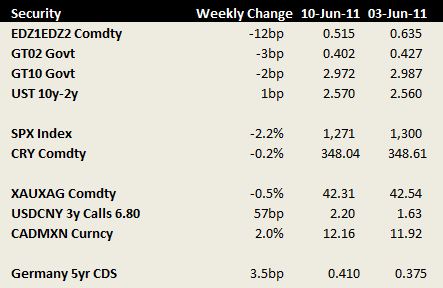
Below some securities changes and some of the bets that I like:


In terms of news flow we had some Fed people on the dovish side of the tape, but not enough to signal another round of QE.

We had some noise in Europe that brought Portuguese 10yr bonds to new highs and hit the Euro badly even after Trichet's hawkish comments. I am not sure if people are worried about the drain in liquidity after more signals that monetary policy will be tightened or if people think that activity isn't strong enough to resist to more tightening or even if this recent move was related to Germany x Greece or Bailout x Greece Referendum fears, etc, etc.. Anyway. I still like the long German 5y CDS bet @ 40bps I posted earlier. Politics will be the answer to the current debt mess and when politicians are involved I expect a bad outcome. Democracies could ruin the big-picture story for Europe. The True Finns in Finland had their go, some in Ireland also and the Greeks now hold the power (with help from the German people, for sure). 

Still, I am not constructive at all with the US economy and with markets trading the way they are trading the economic activity should also slow down even more. And that is globally.
We had more hikes this week from Brazil and South Korea... that doesn't bode well for the global output. A surprising no-hike came from Peru also, but they're a much smaller piece of our puzzle.

Another piece of interesting news out was the Flow of Funds in the US... on that I bring 2 links:

Zero Hedge - Flow Of Funds Update: Aborted Attempt To Hand Over Releveraging From Government To Business Sector?

and

The Big Picture (Barry Ritholtz) - The Great QE2 Flush Out

Interesting facts... for the quarter ending March 31st we had household wealth up USD 1 trillion... of that some large numbers (1.2 trillion) from "corporate equities, mutual fund shares, and pension fund reserves". What has happened to household wealth since then with equity markets declining a bit and housing also declining in price? Will this be negative? Will it affect animal spirits and activity?

Anyway, technicals have turned horrible for a lot of assets and this week's move in stocks brought some of the indexes back to negative territory.
The NASDAQ is down YTD. The US Bank Index is down 10% YTD, the Trannies are now down YTD after holding up very well for weeks...

So...

Those useless weekly charts:


*Disclaimer: charts and data are presented as I receive/see them. Sources are usually not checked for validation and my own calculations are of 'back of the envelope'-type. I am aware that some math that I do myself might be wrong and/or misleading to some extent. In financial markets the rate of change of economic data is often more important than the actual level and the perception of 'what is priced in' is more important than 'what is actually going to happen'. This is actually the way people pick entry and exit points. So... yes, sometimes you might say 'This guy is an idiot, this is way wrong!' with a high conviction, being right. Not to worry. Markets are made of expectations and the clash of conviction between its participants. Portfolio managers know that being an idiot is sometimes profitable and being smart is often a bad choice. It is all reality, sometimes good, sometimes bad. By the way: corrections to my analysis and intelligent debate is welcome. theintriguedtrader AT gmail do com

Friday, June 3, 2011

Weekly Recap, 2011 06 03

Weekly Recap

I was talking to some friends today about what goes on and my take is very simple and straight forward:
- Inflation in EM has picked up markably
- Central Banks around the world have been raising rates steadily to keep the cheap-global-credit from causing an overheat in their economies
- With austerity in many countries, with US QE2 coming to an end, the ECB hiking rates and the Japanese new-QEs being offset by the quake+tsunami issues the markets have stalled because of expectations of a reduction in global liquidity
- Therefore causing economic agents to think twice before further capital expenditures/hires
- And repeat: more volatility and negative performance in risky-assets, less confidence within the corporate community for investments and worse economic numbers

Did the Japanese natural disasters cause all this? Yes and no in my opinion.

How? It seems to me that it certainly helped trigger the slowdown or at least antecipate it.
People were not too confident about the recovery in DM and with the japanese-related hit and outright slowdown in industrial activity they got more cautious therefore agravating the slow down.

With inflation running loose in EM and Central Bankers still behind the curve (and kinda comfortable with that) it seems to me that we're all in a "wait and see" mood.
Everyone is watching global economic numbers closely and hoping that risk-markets won't go bad.

Again, my reading of the recent market moves is that the market is pricing in more easing from the Fed, more liquidity ahead.
Why?

Bonds have been performing very well.
The US-dollar has taken a hit and commodities and equity markets dropped, but not thaaaat much.

So... as Grantham, Howard Marks, Hussman, Stephen Jen and others say, it looks like a bad risk-reward choice right now to be positioned for a risk-on future.


If we embark in a slowdown, especially after QE2 ends, will QE3 come easily? Will more fiscal stimulus come easily? Not likely in the US, not likely in Europe. Will rates be cut more? How? They can't really drop below zero, can they?

This dismal growth in the US is on the back of a never-seen-before fiscal and monetary stimulus and private-sector bail out.

When all this stimulus, or part of it, fades... where will growth come from? The function Growth(Debt growth) has come to its limit and from here on it seems that no matter what happens to credit growth will simply not improve linearly and its marginal usefulness will drop to zero. Or negative: another credit collapse.

Below some charts of things no one cares about:


*Disclaimer: charts and data are presented as I receive/see them. Sources are usually not checked for validation and my own calculations are of 'back of the envelope'-type. I am aware that some math that I do myself might be wrong and/or misleading to some extent. In financial markets the rate of change of economic data is often more important than the actual level and the perception of 'what is priced in' is more important than 'what is actually going to happen'. This is actually the way people pick entry and exit points. So... yes, sometimes you might say 'This guy is an idiot, this is way wrong!' with a high conviction, being right. Not to worry. Markets are made of expectations and the clash of conviction between its participants. Portfolio managers know that being an idiot is sometimes profitable and being smart is often a bad choice. It is all reality, sometimes good, sometimes bad. By the way: corrections to my analysis and intelligent debate is welcome. theintriguedtrader AT gmail do com