Showing posts with label European Debt. Show all posts

Friday, June 24, 2011

Would a German CDS steepener be worth it?

I have spoken before about buying 5y German CDS @ 40bps and still like the idea very much.
Since this bet could take sometime to pay off there is another way to work on this trade which is the steepener.

What are the downsides on the outright long German 5y CDS:
1. Its price going down, of course, out of a 5y duration
2. The play going nowhere for quite sometime and you having to disburse the insurance premium of 40bps/year (which is cheap)

So if you do not like (2) above, as this fight is against policy makers, banks, socialist-capitalism (that transfers bank losses to tax payers), because we do not know WHEN it could actually work selling 2y German protection as a source of funding might look interesting.

Live market prices now are:
2y German CDS: bid @ 17bp
5y German CDS: offer @ 46bp

You do it duration weighted:
Sell 50m 2y @ 17 = receiving 85k USD/year
Buy 20m 5y @ 46 = paying 92k USD/year
Net cost, per year = 7k USD.

Catastrophe Scenario
- Germany defaults overnight: net exposure is 30m USD (50m short x 20m long)
Probability: very low as the German fiscal situation is 'healthy'. Their debt levels are low, their ongoing fiscal gap is reasonable and activity, even though super leveraged to global trade/exports, is very good.
What could change: Greece defaults and german banks get wiped out and global trade comes to a halt
What is bad: they have Euros and they can't print Euros like the US or Japan can, really fast.

My point is: if this Catastrophe Scenario happened overnight YES, the trade would get crushed and the risk-reward would be ridiculously bad.
BUT I really do not think this would happen overnight and things would deteriorate gradually giving us time to exit the trade

An unlikely scenario, but more likely then german default scenario, is things get sour quickly and the German curves goes inverted way too fast.. Two-year spreads go up faster than the 5y-spreads. That is a stop-loss even though you believe the fundamentals backing the trade are sound.
What could make this scenario dangerous is the fact that 2y German CDS spreads are way too low in absolute terms. That's 17bps. Someone who wants to put in their books catastrophe-like hedges that are extremely cheap.. could just outright buy these 1y or 2y babies. This actually bothers me, making me like the 5y-outright-long a lot.

So what is the most-likely scenario in my opinion:

Things keep on deteriorating despite all the talk of "we're OK" from policy makers.
Italian and Spanish sovereign debt goes bad... and slowly Germany is brought into the mess to save everyone else, alongside with France, backing all these packages.
French CDS have already gone a bit wild. It came from sub-70bps to almost 90bps and the same 2y/5y steepener traded at 35 and is now above 50bp levels.
Sounds like a pattern to me. Sounds interesting.

*Disclaimer: charts and data are presented as I receive/see them. Sources are usually not checked for validation and my own calculations are of 'back of the envelope'-type. I am aware that some math that I do myself might be wrong and/or misleading to some extent. In financial markets the rate of change of economic data is often more important than the actual level and the perception of 'what is priced in' is more important than 'what is actually going to happen'. This is actually the way people pick entry and exit points. So... yes, sometimes you might say 'This guy is an idiot, this is way wrong!' with a high conviction, being right. Not to worry. Markets are made of expectations and the clash of conviction between its participants. Portfolio managers know that being an idiot is sometimes profitable and being smart is often a bad choice. It is all reality, sometimes good, sometimes bad. By the way: corrections to my analysis and intelligent debate is welcome. theintriguedtrader AT gmail do com

Policy Makers Give Answers. Markets Grade Them.

Human beings, those behind market movements, are a curious kind.
Was there any important news yesterday to cause the sell-off?
Was there any important news yesterday to cause the rally in the afternoon?

In my humble opinion there wasn't.
First of all we all know already that Greece is insolvent.
Second, every one knows that policy makers will try really hard to keep the ball rolling. Forever.

European policy makers (and the IMF crew, the banks, the Fed, China) will fight for austerity for now, no matter what the consequences are for Greece's growth. Or global inflation. Or the CNYSEK currency cross. That is obvious.
Everyone is worried about the global banking system and (as R.E.M. put it: ) the end of the (capitalist) world as we know it.

Policy Makers are putting moral hazard aside and, learning from the Lehman collapse and its shockwaves, will force any thing possible, within their means, to keep the ball rolling.

Only market prices will solve the european solvency issues. And if the issue's solution is forced by the markets, yes, things won't look good at all.

So.... some charts for you:


*Disclaimer: charts and data are presented as I receive/see them. Sources are usually not checked for validation and my own calculations are of 'back of the envelope'-type. I am aware that some math that I do myself might be wrong and/or misleading to some extent. In financial markets the rate of change of economic data is often more important than the actual level and the perception of 'what is priced in' is more important than 'what is actually going to happen'. This is actually the way people pick entry and exit points. So... yes, sometimes you might say 'This guy is an idiot, this is way wrong!' with a high conviction, being right. Not to worry. Markets are made of expectations and the clash of conviction between its participants. Portfolio managers know that being an idiot is sometimes profitable and being smart is often a bad choice. It is all reality, sometimes good, sometimes bad. By the way: corrections to my analysis and intelligent debate is welcome. theintriguedtrader AT gmail do com

Tuesday, June 21, 2011

Greece 'Essentially Bankrupt' Even With Aid, PIMCO's Balls


I ask myself every once in a while: "What would I do if I were a policy maker in Europe right now?".

It is such a puzzling question because these are well-educated guys who have a huge networking to source point-of-views. They hear a variety of opinions from the likes of politicians, business men, academics, investors, among others and I really believe they know there is no way out of a debt restructuring for the peripherals (considering that once Greece goes the tide comes bringing the rest down to their knees).

What would I do?
Will the Greek people, through their politicians, really let austerity come in harder than it is actually already going?
The creditors didn't worry much about the solvency of the Greek people when they lent the money. Now the situation is so serious that even the Greeks have to think what will happen if they didn't pay back what they owe.
If there is a default would the new global banking + financial crisis make things even worse for stand-alone Greece?
Would the Greeks be better-off defaulting, staring at the financial-crisis-abyss that would ensue, leaving the Eurozone and the Euro currency, with the world in chaos after spending another few depressed years to get their currency back, etc?

I do not know.
But I certainly am happy not to be an european finance minister right now.
Good luck to these guys because the matter they have in their hands is, from my point of view, key to the future of our financial system as we know it.

(I know, the current system sucks).

PIMCO Andrew Balls - The Eurozone Needs a Plan B, as 'Quarantining' the Weak Is Too Costly

Greece ‘Essentially Bankrupt’ Even With Aid, Says Pimco’s Balls
2011-06-21 15:59:06.377 GMT


By Mark McCord
     June 21 (Bloomberg) -- Greece is “essentially bankrupt”
and any attempts to solve its sovereign crisis with a new bailout will be like “kicking the can down the road,” said Andrew Balls, Pacific Investment Management Co.’s head of European portfolio management.
     Even if the nation is granted fresh aid “these issues are going to come up again in the next months,” Balls told Andrea Catherwood on Bloomberg Television today. It would be “complacent if investors think this can be kicked down the road until 2013,” he said.
     Greek Prime Minister George Papandreou faces a confidence vote today as he seeks to secure parliamentary support for austerity measures required for the granting of outside aid to prevent a default.
     Balls said the only benefit of a Papandreou victory would be to buy some time to prevent contagion spreading to other economies such as Spain’s.
     “The concern we have is that if you continue to kick the can down the road, you raise the risk of a disorderly default and worse contagion impact,” he said. “If you just told the truth and said Greece looks like it will need to restructure its debt” you could then “try and have a supportive orderly framework to do that.”

Link to Company News:{1841Z SM <Equity> CN <GO>} Link to Company News:{21429Z US <Equity> CN <GO>}

*Disclaimer: charts and data are presented as I receive/see them. Sources are usually not checked for validation and my own calculations are of 'back of the envelope'-type. I am aware that some math that I do myself might be wrong and/or misleading to some extent. In financial markets the rate of change of economic data is often more important than the actual level and the perception of 'what is priced in' is more important than 'what is actually going to happen'. This is actually the way people pick entry and exit points. So... yes, sometimes you might say 'This guy is an idiot, this is way wrong!' with a high conviction, being right. Not to worry. Markets are made of expectations and the clash of conviction between its participants. Portfolio managers know that being an idiot is sometimes profitable and being smart is often a bad choice. It is all reality, sometimes good, sometimes bad. By the way: corrections to my analysis and intelligent debate is welcome. theintriguedtrader AT gmail do com

Thursday, June 16, 2011

And the funding crisis goes on...

A new day and new prices.

The near-term 90-day eurodollar contracts keep going down (and rates going up, as shown below) even though more signs of slowing activity come our way (yesterday's Empire and Industrial Production in the US, today the Retail Sales numbers in the UK).

That smells like floating banking bodies around if you would ask me.

And then we have what I feared yesterday: Spanish and Italian 10yr bonds breaking to the upside, shown on the charts down below.

God bless paellas and spaghetti.


*Disclaimer: charts and data are presented as I receive/see them. Sources are usually not checked for validation and my own calculations are of 'back of the envelope'-type. I am aware that some math that I do myself might be wrong and/or misleading to some extent. In financial markets the rate of change of economic data is often more important than the actual level and the perception of 'what is priced in' is more important than 'what is actually going to happen'. This is actually the way people pick entry and exit points. So... yes, sometimes you might say 'This guy is an idiot, this is way wrong!' with a high conviction, being right. Not to worry. Markets are made of expectations and the clash of conviction between its participants. Portfolio managers know that being an idiot is sometimes profitable and being smart is often a bad choice. It is all reality, sometimes good, sometimes bad. By the way: corrections to my analysis and intelligent debate is welcome. theintriguedtrader AT gmail do com

Wednesday, June 15, 2011

And the European Debt market doesn't look any good...

So last night Moody's put BNP Paribas, SocGen and Credit Agricole, french banks, on review, with negative outlook due to Greek debt in their balance sheets.
We got news from European officials that nothing was decided about the Greek bailout and this will have to wait until July.

Even with european industrial production numbers coming in better than expected (+0.2% vs expected -0.2%) the EUR took a beating against the USD, the CHF and other currencies.

And... the European Periphery Debt charts look horrible. Worse than 2 days ago.
What will happen if Spain or Italy break-out to the upside?

I don't want to be caught long these securities, that I am sure.


*Disclaimer: charts and data are presented as I receive/see them. Sources are usually not checked for validation and my own calculations are of 'back of the envelope'-type. I am aware that some math that I do myself might be wrong and/or misleading to some extent. In financial markets the rate of change of economic data is often more important than the actual level and the perception of 'what is priced in' is more important than 'what is actually going to happen'. This is actually the way people pick entry and exit points. So... yes, sometimes you might say 'This guy is an idiot, this is way wrong!' with a high conviction, being right. Not to worry. Markets are made of expectations and the clash of conviction between its participants. Portfolio managers know that being an idiot is sometimes profitable and being smart is often a bad choice. It is all reality, sometimes good, sometimes bad. By the way: corrections to my analysis and intelligent debate is welcome. theintriguedtrader AT gmail do com

Monday, June 13, 2011

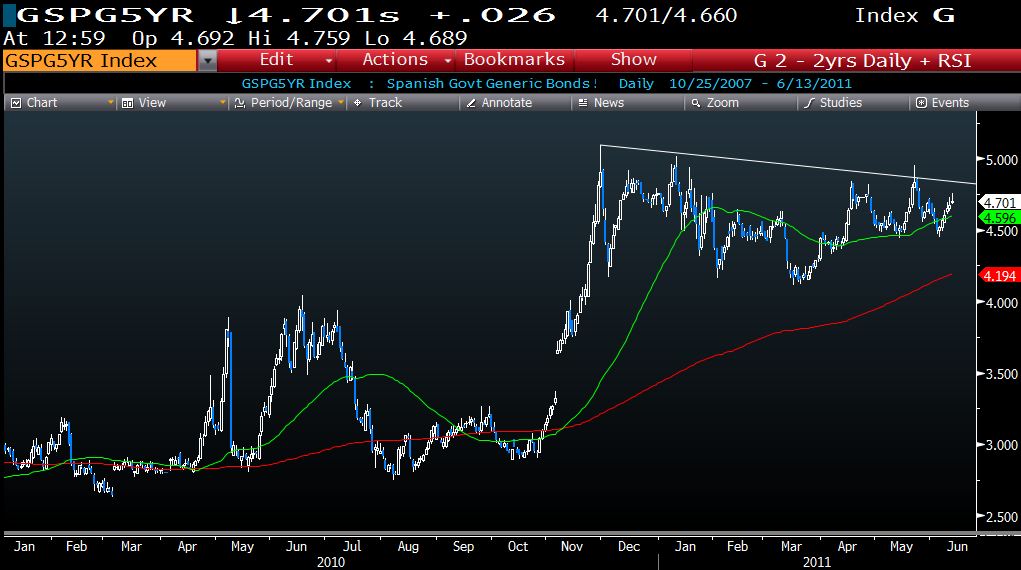
And the European Debt market doesn't look too good...

Just a few charts to illustrate how the market is looking at the whole sovereign debt debacle, spreading over to the banking sector.

Portuguese 5y and 10y bonds have now reached new yield-highs.
The longer-maturity bonds from Italy and Spain are looking dangerous yield-wise. Flag formations there. If a break-out to the upside occurs it should be nasty.

What are the cards like up european policy makers sleeves?

Then scroll down for bank stocks.
French banks have done alright. Still well from 2010's lows.
On the other hand... Spanish banks are a bit worse.
And Italian banks have been disastrous. Close to 2009's lows.
And for comparison, Bank of America (BAC) is not well either...

Italian 2y Bonds:


Italian 5y Bonds:


Italian 10y Bonds:


Portuguese 2y Bonds:


Portuguese 5y Bonds... 


Portuguese 10y Bonds...


Spanish 5y Bonds:


Spanigh 10yr Bonds:


*Disclaimer: charts and data are presented as I receive/see them. Sources are usually not checked for validation and my own calculations are of 'back of the envelope'-type. I am aware that some math that I do myself might be wrong and/or misleading to some extent. In financial markets the rate of change of economic data is often more important than the actual level and the perception of 'what is priced in' is more important than 'what is actually going to happen'. This is actually the way people pick entry and exit points. So... yes, sometimes you might say 'This guy is an idiot, this is way wrong!' with a high conviction, being right. Not to worry. Markets are made of expectations and the clash of conviction between its participants. Portfolio managers know that being an idiot is sometimes profitable and being smart is often a bad choice. It is all reality, sometimes good, sometimes bad. By the way: corrections to my analysis and intelligent debate is welcome. theintriguedtrader AT gmail do com